

Case study · E-commerce platform

GameBend: a digital-games marketplace, built and run end to end

GameBend is a live marketplace for game keys and software licences, sold across Europe in English and Greek. We designed the architecture, built it end to end, and run it in production — search, checkout, VAT, fraud screening and delivery automation.

GameBend storefront homepage with a featured-game carousel and best-selling game cards

At a glance

searchable products
120,000+
machine-translated product texts
260,000+
storefront languages, English and Greek
2
from payment to key in the inbox
Minutes

Figures as of September 2026.

The problem

A huge catalogue, sold legally across borders, with nobody in the loop

A digital-goods store lives or dies on three things: whether people can find the exact edition and platform they want, whether the price they pay is correct for where they live, and how fast the key arrives. GameBend needed all three for a catalogue of well over a hundred thousand products that changes every day.

Every sale also carries legal weight. EU customers pay the VAT rate of their own country, and every transaction needs a signed fiscal receipt reported to the Greek tax authority. Card fraud targets digital goods relentlessly, because a stolen card turns into a redeemable key within minutes.

The goal was a storefront that handles all of this automatically — no manual step per sale — and that a very small team can operate with confidence.

Architecture

One storefront, a few sharp services

Next.js renders the storefront and owns every transactional rule. Postgres is the source of truth; Typesense serves browsing and search; background jobs do the slow and retry-prone work so customers never wait on it.

  1. Live requests

    Shoppers

    EN · EL

    Browse, search and pay in English or Greek

  2. Storefront

    Next.js

    Next.js 16 App Router, React 19 Server Components, bilingual routing

  3. Search

    Typesense

    Typesense collection as the primary read path for browse and search

    Database

    Supabase Postgres

    Supabase Postgres, Auth and row-level security; transactional SQL functions

    Payments & tax

    Stripe

    Stripe Payment Intents with 3-D Secure and Stripe Tax

  4. Async, retried until done

    Background jobs

    Trigger.dev

    Trigger.dev queues for delivery, receipts, catalogue sync and translation

  5. Fiscal receipts

    AADE myDATA

    Signed receipts reported to the Greek tax authority (myDATA)

    Email delivery

    Resend

    Resend with React Email templates for keys and receipts

    AI translation

    OpenAI

    Product texts translated by a scheduled job, validated against a schema and a shared glossary

How it works

Checkout & tax

Checkout that charges the right VAT, or refuses to guess

Checkout uses Stripe Payment Intents with Stripe Elements. Before a payment is created, a single Postgres function reserves stock and writes the order atomically, and Stripe Tax calculates the destination VAT for the customer's country.

If the tax calculation fails for an EU customer, checkout stops rather than charging a guessed rate. Webhooks are idempotent, so a retried event can never fulfil or refund an order twice.

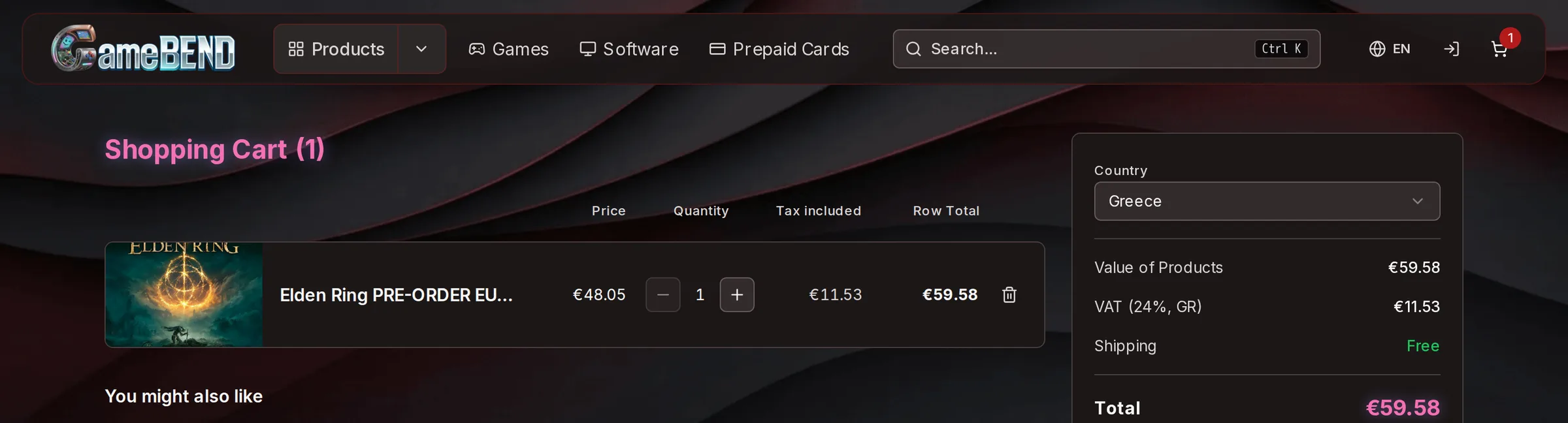
  • Destination VAT shown line by line in the cart
  • Layered rate limiting on checkout
  • Signed fiscal receipt issued for every sale, voided automatically on a full refund
GameBend cart with one game, the VAT breakdown for Greece, and the order total
  1. 1Cart and country
  2. 2Stock reserved, order written
  3. 3Destination VAT calculated
  4. 4Payment with 3-D Secure
  5. 5Webhook confirms, receipt issued
Delivery & fraud screening

Keys arrive in minutes — but only for payments that are really authorised

A successful card payment only proves the bank approved it, not that the cardholder did. After real carding attempts, we added a 3-D Secure gate: baskets with a higher fraud risk must pass full cardholder authentication, and the check fails closed.

Payments that do not clear the bar are refunded automatically instead of fulfilled. Everything else is handed to an idempotent background job that delivers the key by email, retrying safely if any step fails.

  • Card, IP and billing-country evidence recorded on every payment
  • Automatic refunds instead of a manual review queue
  • Delivery jobs keyed per order, so retries never send twice
GameBend product page showing activation regions, price with VAT, and key delivery by email within five minutes
Localisation

A fully Greek storefront without a translation team

The interface is translated by hand; product descriptions and activation instructions are translated by an AI pipeline running as a scheduled background job, validated against a schema and a shared glossary.

Each text is fingerprinted by content, so boilerplate shared by thousands of products is translated once and reused. When a description changes, its translation is invalidated and redone on the next run.

  • Locale-aware routing with search-friendly URLs in both languages
  • Translation reuse keyed on a content hash
  • Stale translations invalidated automatically when source text changes
  1. 1Product text changes
  2. 2Content hash checked
  3. 3Reuse an existing translation
  4. 4Or translate and validate
  5. 5Pages revalidated
Stack

The stack

Boring where it should be, specialised where it pays off. Every piece is typed, tested and observable.

Application

  • Next.js 16
  • React 19
  • TypeScript
  • Tailwind CSS 4
  • Radix UI

Data & search

  • Supabase Postgres
  • Postgres RLS
  • Typesense

Payments & compliance

  • Stripe Payment Intents
  • Stripe Tax
  • AADE myDATA

Automation

  • Trigger.dev
  • OpenAI
  • Resend
  • React Email

Quality & operations

  • Vitest
  • Biome
  • pino
  • PostHog
  • Vercel
Start a conversation

Need a platform that has to work on day one?

We design, build and run production systems — search, payments, compliance and automation included. Tell us what yours has to do.